


Sophos AI Defense Explained
Posted by Saif Khan on 2026 Oct 16th
Sophos AI Defense is an add-on for Sophos EDR, XDR and MDR that shows which AI tools and agents your people use, rates how risky each one is, and lets you block, warn about or allow them by policy. Sophos made it generally available on October 13, 2026. It runs on Sophos Fusion and reads data from Sophos sensors you already have, so there is nothing new to deploy.
Ask most IT managers which AI tools their company uses and you get a short, confident list. Ask again after a few weeks of watching the network and the list is a lot longer: personal chatbot accounts, browser extensions, AI coding tools, an agent someone wired into a shared drive. AI Defense is built to replace the first list with the second, and then let you decide what stays.
Sophos AI Defense at a glance
| Question | Answer |
|---|---|
| What it is | An add-on that finds, rates and controls AI use across your organization |
| Sold with | Sophos EDR, Sophos XDR or Sophos MDR. Not sold on its own |
| Runs on | Sophos Fusion, which Sophos calls the evolution of Sophos Central |
| Gets data from | Sophos Endpoint, Sophos Firewall, DNS Protection, Protected Browser and Sophos Data Lake |
| Policy actions | Allow Warn Block |
| Available | Generally available since October 13, 2026 |
| Price | Quoted. Sophos does not publish a list price. Get a quote |
What is shadow AI?
Shadow AI is any AI tool or agent used for work without IT approval. A personal ChatGPT account counts. So does a browser extension that summarizes email, or an AI agent with access to a shared drive that nobody signed off on.
Most of it is well meant. People use these tools because they save time. The risk is what goes into them: customer records, source code, pricing and contracts, sent to services your business has no agreement with and no control over.
The numbers Sophos cites at launch (see the Sophos announcement for each source):
| Finding | Source |
|---|---|
| 69% of cybersecurity leaders suspect or have evidence that employees use unsanctioned AI tools | Gartner survey of 302 cybersecurity leaders, November 2025 |
| 82% of organizations found shadow AI agents in their environment in the past year | Cloud Security Alliance, April 2026 |
| 90% of IT leaders are concerned about shadow AI risk | Komprise survey of 200 US IT leaders, June 2025 |
| 1.3 billion AI agents are projected by 2028 | IDC, May 2025 |
Attackers are using AI too. In one case from this year, Sophos X-Ops found an attacker using AI agents inside a customer's network to build and test nearly 80 malware modules.
What Sophos AI Defense does
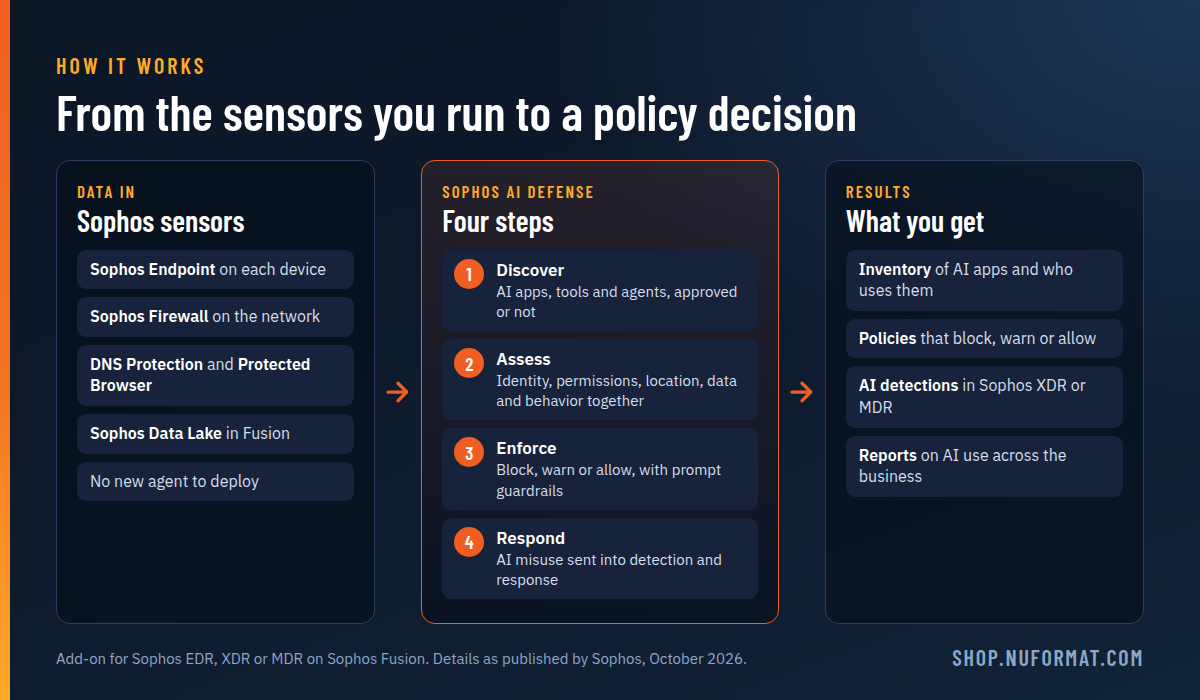
Sophos splits the product into four steps. Here is what each one means in practice.
| Step | What it does | What you get |
|---|---|---|
| 1. Discover | Finds AI apps, tools and agents in use across users and devices, including ones nobody approved | An inventory of AI apps and who uses them |
| 2. Assess | Weighs identity, permissions, location, data access and behavior together, not one at a time | Real risk separated from routine use |
| 3. Enforce | Applies your policy, with guardrails on prompts and agent behavior and checks on prompts and uploads as they happen | People steered to approved tools; sensitive data kept out of the rest |
| 4. Respond | Treats AI misuse as a security signal and sends it into detection and investigation | AI detections in the same queue as every other threat |
Inside Sophos Fusion, AI Defense has its own dashboard, plus pages for activity, inventory, detections, reports and policies.
Which AI tools does it see?
Sophos documentation names two groups of AI apps:
| Type of AI app | Examples Sophos gives |
|---|---|
| Browser-based AI chat | ChatGPT, Claude.ai, Copilot |
| Coding, desktop and agent apps | Claude Code, Cursor, OpenClaw |
Each app carries characteristics such as a risk level and whether it meets industry standards. Those are what your policy rules match on, so you can write one rule for every medium-risk app instead of chasing app names one at a time.
Where AI Defense gets its data
AI Defense does not add a new agent. It reads from Sophos sensors, and the more of them you run, the more places it can see AI use.
| Sensor | Where it sees AI use | Where to get it |
|---|---|---|
| Sophos Endpoint | On each device | Sophos Endpoint and EDR |
| Sophos Firewall | On the network | Sophos XGS firewalls |
| DNS Protection | In domain lookups | Sophos Workspace Protection |
| Protected Browser | In the web browser | Sophos Workspace Protection |
| Sophos Data Lake | Across the data Sophos Fusion already collects | Sophos XDR or Sophos MDR |
Good to know: AI Defense policies are enforced through Sophos Endpoint or Sophos Firewall. When you set a policy's scope, Fusion shows which of the two it will apply to.
Block, warn or allow: how AI Defense policies work
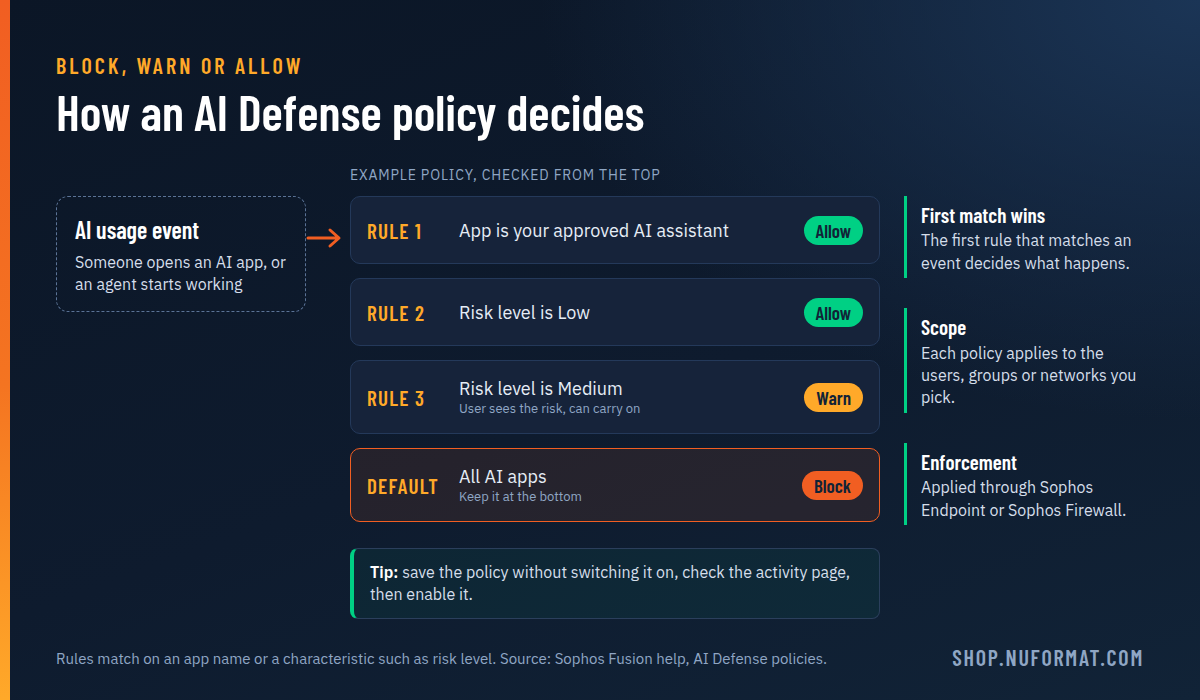
- Each rule takes one action. It can block the AI app, allow it, or warn the user about the risk and let them carry on.
- A rule matches on an AI characteristic, such as risk level or compliance with industry standards, or on an app name. One rule can stack several filters.
- Each policy applies to the users, groups or networks you choose.
- Rules are checked from the top. The first rule that matches an AI event decides what happens to it.
- The default rule blocks all AI apps. Sophos recommends keeping it at the bottom and adding allow rules above it.
- You can start from a Sophos template, clone a policy, or save one without switching it on.
Here is what a simple first policy could look like for an office that pays for one AI assistant. Adjust it once you see your own activity data.
| Order | Rule matches | Action | Why |
|---|---|---|---|
| 1 | App is your company's approved AI assistant | Allow | The tool you pay for and have an agreement with |
| 2 | Risk level is Low | Allow | Low-risk tools stay open for everyday work |
| 3 | Risk level is Medium | Warn | People can carry on, but they see the risk first |
| Default | All AI apps | Block | Anything not matched above is stopped |
What you need to run it
| Requirement | Details |
|---|---|
| Base subscription | Sophos EDR, Sophos XDR or Sophos MDR |
| Platform | Your Sophos account upgraded to Sophos Fusion |
| Sensors | Any of Sophos Endpoint, Sophos Firewall, DNS Protection or Protected Browser. Policies are enforced through Endpoint or Firewall |
| License | Add-on to your EDR, XDR or MDR subscription |
| Timing | Sophos is moving accounts to Fusion in phases. Ask us where yours is |
EDR, XDR or MDR: which one should you pair it with?
AI Defense works the same way on all three. The difference is who looks at the alerts it raises.
| Sophos EDR | Sophos XDR | Sophos MDR | |
|---|---|---|---|
| Covers | Endpoints and servers | Endpoints plus firewall, email, cloud and third-party tools | Everything in XDR, run by Sophos |
| Who handles AI Defense alerts | Your team | Your team | Sophos analysts, 24/7 |
| Good fit for | A small IT team focused on devices | A team that investigates across many tools | No in-house security team, or no one on nights and weekends |
| See it | Sophos EDR | Sophos XDR | Sophos MDR |
Pricing for MDR, the most common pairing, is covered in our MDR pricing guide.
Sophos AI Defense or TrendAI AI security?
They solve different problems. Sophos AI Defense is about people using AI safely at work. TrendAI's AI products are mostly about building AI safely: the chatbots, AI features and agents your own developers ship.
| The job | Product | What it covers |
|---|---|---|
| Control how staff use AI tools | Sophos AI Defense | Discover, assess, enforce and respond across endpoint, network and browser |
| Stop sensitive data going to GenAI services | TrendAI ZTSA AI Service Access | Inspects traffic to GenAI services and stops sensitive data going out |
| Secure the AI apps and agents you build | TrendAI Vision One AI Security | Protection for AI apps and agents from development to runtime |
Our AI Defense page maps six common AI risks to the standards behind them and the products that close each gap.
How to roll out Sophos AI Defense in five steps
- Check your base. Confirm you have Sophos EDR, XDR or MDR, and that your account is on Sophos Fusion.
- Look before you block. Turn AI Defense on and give the activity and inventory pages a couple of weeks. The real list of AI tools in use is rarely the one you expect.
- Write the rule down. An AI policy says which tools are approved and what data can go into them. Our virtual CISO service can write it with you.
- Build the policy. Allow approved tools, warn on medium risk, and leave the default block at the bottom. Save it, check the scope, then switch it on.
- Keep the evidence. AI detections land in XDR or MDR. Add Sophos Next-Gen SIEM to keep logs for 13 months or longer for auditors and insurers. Our Next-Gen SIEM guide explains how.
Frequently asked questions
What is Sophos AI Defense?
Sophos AI Defense is an add-on for Sophos EDR, Sophos XDR and Sophos MDR that finds the AI tools and agents people in your organization use, rates the risk of each, and lets you block, warn about or allow them by policy. It runs on Sophos Fusion and sends AI activity into detection and response.
Is Sophos AI Defense available now?
Yes. Sophos announced general availability on October 13, 2026. Your Sophos account needs to be on Sophos Fusion, which Sophos is rolling out to accounts in phases.
Can I buy Sophos AI Defense on its own?
No. It is sold only as an add-on to Sophos EDR, Sophos XDR or Sophos MDR.
Does Sophos AI Defense block ChatGPT?
Only if your policy says so. Each rule can block, warn about or allow an AI app, matched by app name or by a characteristic such as risk level, for the users, groups or networks you choose. A common setup allows approved tools and blocks the rest.
Which AI tools can Sophos AI Defense detect?
Sophos documentation names browser-based AI such as ChatGPT, Claude.ai and Copilot, and coding, desktop and agent apps such as Claude Code, Cursor and OpenClaw.
Do I need to install anything new for Sophos AI Defense?
No new agent. AI Defense uses data from Sophos sensors you already run: Sophos Endpoint, Sophos Firewall, DNS Protection, Protected Browser and Sophos Data Lake. Policies are enforced through Sophos Endpoint or Sophos Firewall.
How much does Sophos AI Defense cost?
Sophos does not publish a list price. It is licensed as an add-on to your EDR, XDR or MDR subscription, and Nuformat quotes it in US or Canadian dollars against your current Sophos products and seat count.
What is the difference between Sophos AI Defense and Sophos Fusion?
Sophos Fusion is the platform, which Sophos describes as the evolution of Sophos Central. AI Defense is one add-on that runs on it.
Want AI Defense quoted with your current Sophos setup? Tell us which Sophos products you run and how many users. We reply with pricing in US or Canadian dollars.
Related: Sophos AI Defense · AI Defense for business · Sophos MDR · Sophos XDR · Sophos CISO Advantage explained · Sophos Fusion and HWaaS updates
Sources: Sophos press release, October 13, 2026 · Sophos blog: Sophos AI Defense · Sophos AI Defense solution brief · Sophos Fusion help: AI Defense · AI Defense policies. Product details as published by Sophos, October 2026. Nuformat is a Sophos Silver Partner serving businesses in Canada and the USA.