


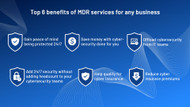
6 Benefits of MDR for Your Business
Posted by Saif Khan on 2024 Aug 27th
Managed detection and response (MDR) gives a business a security team that watches its systems 24/7, hunts for attackers, and stops attacks as they happen, without hiring that team. The six benefits below are the ones owners and IT managers raise most often when they compare MDR with running security in-house. The examples use Sophos MDR, which Sophos says protects more than 40,000 organizations.
1. Someone is watching at 2 a.m.
Attacks do not keep office hours. Ransomware crews like to start encrypting on a Friday night or a holiday weekend, when nobody is at a desk to notice. Alerts that land at 2 a.m. and get read at 9 a.m. give an attacker seven hours of free rein.
With MDR, a Sophos analyst sees that alert at 2 a.m. and acts on it at 2 a.m. The service runs 24 hours a day, 365 days a year, with regional security operations teams sharing the work around the clock.
2. A full security team without the hiring
Covering every hour of the week in-house takes more people than most businesses expect. A week has 168 hours. One analyst works about 40 of them. That is more than four full-time analysts just to keep one seat filled, before vacations, sick days, training, or turnover, and experienced security analysts are hard to hire and harder to keep.
MDR turns that into a subscription priced per user and per server. You get analysts, threat hunters, and incident responders for less than the cost of building the team yourself, and you can scale up or down as your headcount changes.
3. Your IT team gets its week back
In most small and mid-sized businesses, security is one job among many for the IT team. Every hour spent chasing a suspicious login is an hour not spent on projects, users, or the backlog. Worse, a busy team starts to tune out alerts, and the one that matters gets missed.
MDR takes the triage off their plate. Sophos investigates the alerts, closes the false alarms, and escalates only what needs your attention, with clear remediation steps. Cases and reports sit in the Sophos Fusion console in plain language your team and your board can read.
4. Faster response when it counts
The damage from an attack grows with every minute it runs. Speed is where MDR earns its keep:
- 89 seconds from alert to automated response, the figure Sophos publishes for its MDR service.
- 30 minutes is the Sophos target from case creation to first action by an analyst, on both MDR tiers.
- 60 minutes for 90% of priority investigations is a contractual commitment on Sophos MDR Plus, backed by service credits.
You also choose how much authority Sophos has. In Authorize mode, Sophos isolates hosts, kills processes, and blocks attackers first and tells you after. In Collaborate mode, it takes no action without your written OK. In Notify only mode, it investigates and you carry out the fix.
5. It works with the tools you already have
MDR does not have to mean ripping out your current security. Sophos MDR uses Sophos protection where you run it, and it also takes telemetry from third-party tools, including Microsoft Defender for Endpoint, CrowdStrike, and SentinelOne. Coverage reaches endpoints, servers, firewalls, cloud, email, and identity, so an attacker who moves from a phished mailbox to a server is still in view.
6. Stronger footing for cyber insurance
Cyber insurance applications increasingly ask whether you run endpoint detection and response and whether anyone monitors it around the clock. MDR lets you answer yes to both, which puts you in a stronger position at application and renewal time. Coverage and premiums are still the insurer's decision, so treat MDR as a strong point in your favor rather than a guarantee.
Sophos MDR Plus goes a step further with a breach protection warranty: up to US$1,000 per breached endpoint, up to US$1 million a year. It starts after a 60-day waiting period, needs a 12-month subscription, and requires timely patching and the Authorize or Collaborate-then-Authorize response mode.
In plain terms: MDR is a security operations center you rent instead of build. You keep running your business; Sophos watches for attackers every hour of the year and steps in when one shows up.
Sophos MDR or MDR Plus?
Both tiers include 24/7 monitoring, threat hunting, and threat response. The difference is who finishes the job after a confirmed breach. With Sophos MDR, Sophos contains the threat and gives you remediation guidance. Sophos MDR Plus adds full incident response with no hourly caps, an assigned incident response advisor, root cause analysis, the contractual response time, and the warranty. If you have no in-house security team, MDR Plus is usually the better fit.
Compare the two side by side on our Sophos MDR page, or read how Sophos MDR Plus reduces ransomware risk.
Frequently asked questions
What is MDR in cybersecurity?
MDR, or managed detection and response, is a service where an outside security team monitors your systems 24/7, hunts for threats, and responds to attacks for you.
How is MDR different from EDR or XDR?
EDR and XDR are tools your own team runs. MDR is a managed service: the provider runs detection and response for you, so you get the outcome without the staffing.
Is MDR only for large companies?
No. Small and mid-sized businesses often get the most from MDR, because they are the least able to staff a 24/7 security team. Sophos MDR is sold in user bands starting at 1 to 9 users.
Can Nuformat set up Sophos MDR for us?
Yes. Nuformat is a Sophos Silver Partner. We size the tier, handle the licensing, help with onboarding, and support you after the sale, for businesses in Canada and the USA.
Get a Sophos MDR quote · Compare Sophos MDR and MDR Plus · Sophos MDR for servers