


How to Build a High-Performance Network with Sophos: Choosing the Right Firewall, Switch, and Wireless Access Point
Posted by undefined Saif Khan on 2025 Apr 16th
A firewall, a switch, and a set of access points can each be excellent on their own and still give you a slow network. The speed you actually get is set by the weakest link between them. Plan the three together, size them properly, and give every hop enough bandwidth, and you get a fast, secure network you manage from one place. This guide walks the three pieces of a Sophos network and, importantly, how they connect for high-speed performance.
Start with the bottleneck, not the box
Wi-Fi 6 and Wi-Fi 6E push a lot more traffic than older wireless. If that traffic then squeezes through a 1 Gigabit switch port, the switch becomes your ceiling. The fix is to run 2.5 Gigabit Ethernet (2.5 GbE) end to end: a 2.5 GbE access point, plugged into a 2.5 GbE switch port, with enough Power over Ethernet to run the access point over that same cable. Switches also tend to outlast firewalls and access points, so buying 2.5 GbE now is a sensible hedge even if today's traffic does not demand it yet.
1. The firewall: Sophos XGS
The firewall is the control point for everything entering and leaving your network. Size it by how many users sit behind it and how fast your internet connection is, then match the licensing to the protection you want. Sophos XGS runs the same firewall software across every model, so the features are identical from a small desktop unit to a 2U rackmount appliance; what changes is throughput and port count. For a high-speed build, check the firewall has the interface speeds to feed your switching layer rather than throttle it.
2. The switch: Sophos CS series
Sophos access-layer switches are cloud-managed from Sophos Central, the same console as your firewall and access points. Two things matter for a fast Wi-Fi deployment: port speed and Power over Ethernet.
- 2.5 GbE ports so the wired side keeps pace with modern access points. The CS210 series (for example the CS210-8FP with eight 2.5 GbE ports, and the larger CS210-24FP and CS210-48FP) is the multi-gigabit line.
- Full Power over Ethernet so each access point gets both data and power from one cable, with no separate power adapters cluttering the ceiling.
For a small site with one or two access points, a Power over Ethernet injector can power them without a switch. Once you have several access points on walls and ceilings, a PoE switch is tidier and cheaper than a pile of injectors, and it puts everything in one console.
3. The access points: Sophos AP6 (Wi-Fi 6 and 6E)
The AP6 Series is Sophos' current generation of access points, managed from Sophos Central with no local controller required. There are four indoor models and one outdoor model, spanning Wi-Fi 6 and Wi-Fi 6E. Wi-Fi 6E adds the cleaner 6 GHz band, which is less congested and a good fit for the latest devices. One point to plan around: every AP6 model except the AP6 420 has a built-in 2.5 GbE port, which is exactly what pairs with a 2.5 GbE switch for end-to-end speed.
| AP6 model | Wi-Fi | Uplink | Power required | Recommended switch |
|---|---|---|---|---|
| AP6 420 | Wi-Fi 6 | 1 GbE | PoE+ (802.3at) | Any 1 GbE PoE switch (1G is more cost-effective; a 2.5G switch also works) |
| AP6 420X (outdoor) | Wi-Fi 6 | 2.5 GbE | PoE+ (802.3at) | Any 2.5 GbE switch |
| AP6 840 | Wi-Fi 6 | 2.5 GbE | PoE+ (802.3at) | Any 2.5 GbE switch |
| AP6 420E | Wi-Fi 6/6E | 2.5 GbE | PoE+ (802.3at) | Any 2.5 GbE switch |
| AP6 840E | Wi-Fi 6/6E | 2× 2.5 GbE (use both) | PoE++ (802.3bt) | 2.5 GbE switch; power from a CS210-8FP or a PoE++ injector |
The high-speed pairing, in one line: put a 2.5 GbE AP6 model (any except the AP6 420) on a 2.5 GbE Sophos CS210 switch port, powered by that switch, and you have an end-to-end 2.5 Gigabit path with no wired bottleneck. Plan the power to match the access point: most AP6 models run on standard PoE+ (802.3at), but the AP6 840E needs the higher-power PoE++ (802.3bt), so pick a switch or injector that supplies it.
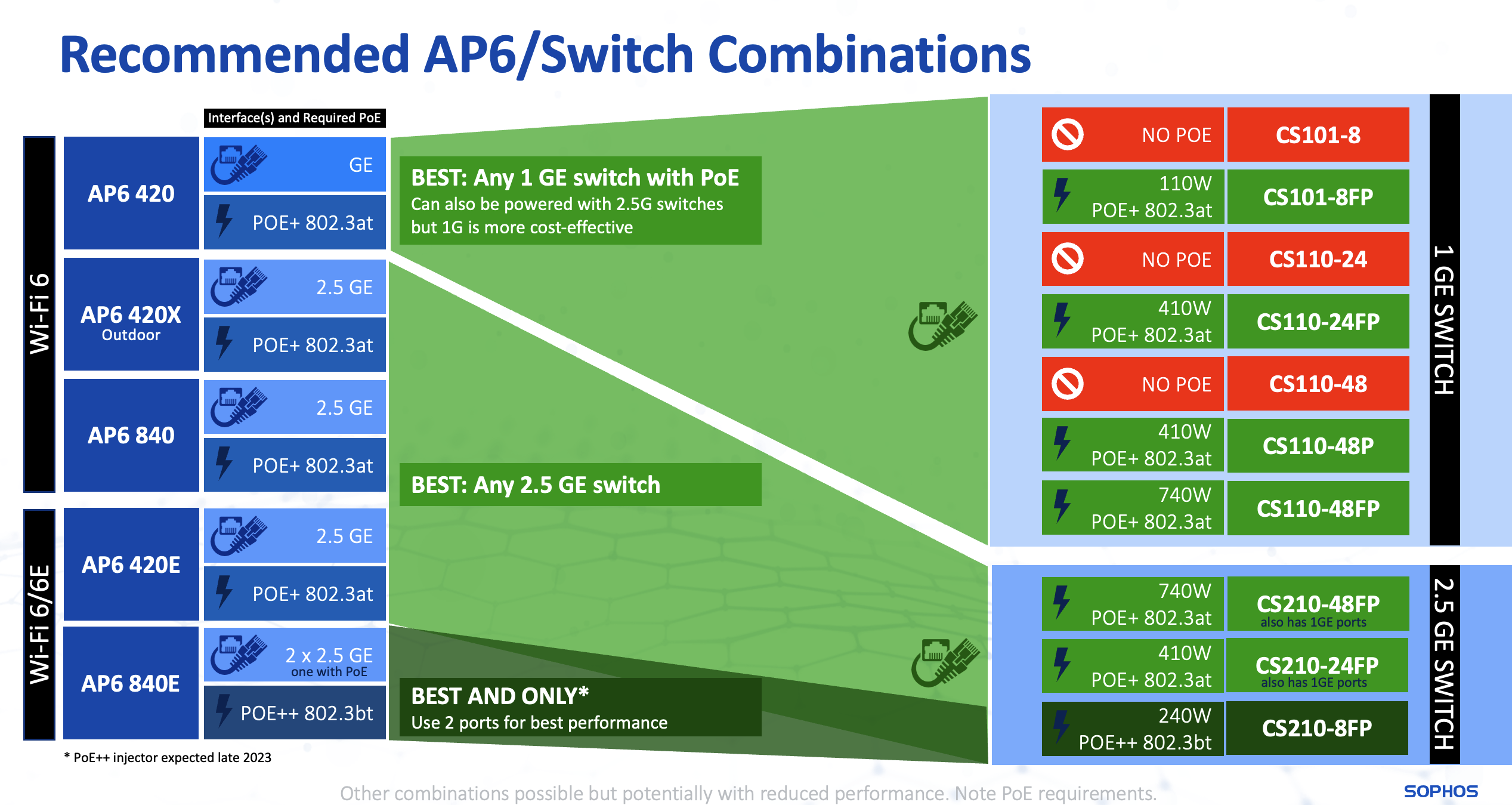
Sophos switches, by port speed and PoE
Sophos access-layer switches fall into two families. Match the family to your access points, and check the PoE, because not every model powers every access point.
| Switch family | Model | PoE | Notes |
|---|---|---|---|
| 1 GbE (CS101 / CS110) |
CS101-8FP | PoE+ (802.3at), 110W | Small office, 8-port |
| CS110-24FP | PoE+ (802.3at), 410W | 24-port | |
| CS110-48P | PoE+ (802.3at), 410W | 48-port | |
| CS110-48FP | PoE+ (802.3at), 740W | 48-port, higher power budget | |
| 2.5 GbE (CS210) |
CS210-8FP | PoE++ (802.3bt), 240W | The 2.5G model that supplies PoE++ for the AP6 840E |
| CS210-24FP | PoE+ (802.3at), 410W | Also has 1 GbE ports | |
| CS210-48FP | PoE+ (802.3at), 740W | Also has 1 GbE ports |
Non-PoE versions also exist (CS101-8, CS110-24, CS110-48). To power access points over the network cable, choose a PoE model (the P and FP versions).
The one gotcha to plan for: the AP6 840E needs PoE++ (802.3bt), and among the 2.5G switches only the CS210-8FP supplies it. The CS210-24FP and CS210-48FP provide PoE+ (802.3at), so if you are deploying an 840E on a larger 2.5G switch, plan to power it from a CS210-8FP or a separate PoE++ injector, and use both of its 2.5 GbE ports for best performance.
How the pieces connect for speed
Read the path from the internet inwards and make sure no hop is slower than the ones around it:
- Internet to firewall: the Sophos XGS handles inspection at the edge. Size it for your connection speed and user count.
- Firewall to switch: connect the firewall to the switch at the highest speed both support so the switching layer is fed, not starved.
- Switch to access point: use a 2.5 GbE switch port to a 2.5 GbE access point, powered over the same cable. This is where most older networks lose speed.
- Access point to devices: Wi-Fi 6 or 6E delivers the airtime; the 6E models add the 6 GHz band for the newest clients.
One console for all of it
Firewall, switches, and access points are all managed from Sophos Central. That means one login to configure, monitor, and troubleshoot the whole network, without switching between tools or running a separate wireless controller. It also keeps your Wi-Fi part of the same security picture as everything else you run in Central.
Putting it together
A properly sized Sophos firewall, a 2.5 GbE PoE switch, and modern AP6 access points form a fast, secure, centrally managed network. The detail that decides whether it actually runs fast is the wiring speed between them and the power that reaches each access point. Get the 2.5 GbE path and the PoE right, and the network performs the way the hardware promises.
Not sure which firewall, switch, and access-point combination fits your site? Tell us your user count, floor area, and internet speed, and we will size the three together and quote a matched set. Explore Sophos firewalls, switches, and access points, and ask us about curated bundles, at shop.nuformat.com.
Tags: which Sophos firewall, switch, and access point for high-speed connectivity and high availability; which Sophos firewall, switch, and access point support 2.5G connectivity; Sophos AP6 2.5G switch compatibility; Sophos CS210 PoE switch; AP6 840E PoE++.